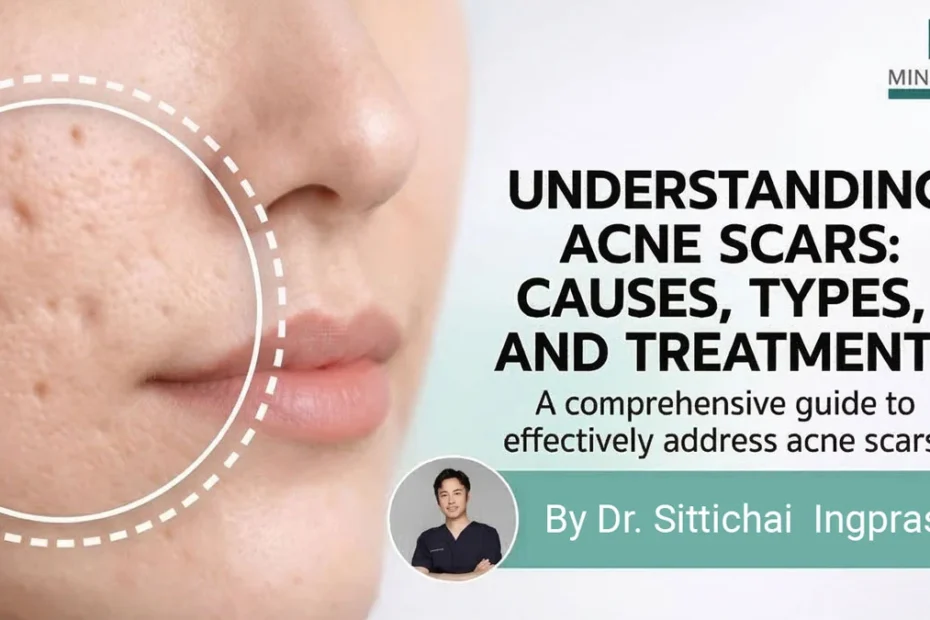
At Mingkwan Clinic, one of the most common concerns we see is acne scarring. These scars often develop after moderate to severe inflammatory acne. Many patients notice that even after the pimples have healed, the skin does not return to a smooth texture and small depressions or uneven areas remain.
Acne scars are not caused by acne alone. They develop when inflammation damages the collagen and supporting structure beneath the skin. Once this deeper tissue is injured, the body may not be able to rebuild collagen completely, and the area can heal with a depressed scar.
In this article, I will explain what causes acne scars, the main types of acne scars, and how treatment is selected based on each person’s scar pattern and skin structure.
Contents – Click to read
- What Causes Acne Scars: When Inflammation Damages Skin Structure
- Why Some People Get Significant Scarring Even Without Severe Acne
- What Are the Main Types of Acne Scars?
- How to Check Your Acne Scar Type in the Mirror in 30 Seconds
- The Truth About Treatment: Why One Procedure Cannot Treat Every Type of Acne Scar
- Combination Therapy: A Layer-by-Layer Treatment Approach
- Why Acne Scar Treatment Often Involves Some Downtime
- Factors That Affect How Easy or Difficult Treatment May Be
- Why Results Cannot Be Judged in the First 1–2 Weeks After Treatment
- Why Acne Scars May Continue to Improve for Months After Treatment
- A Doctor’s Perspective: Why Individual Assessment Matters
- Can Acne Scars Be Completely Removed?
- FAQ: Frequently Asked Questions About Acne Scars
What Causes Acne Scars: When Inflammation Damages Skin Structure

When inflammatory acne develops, the body sends immune cells to the follicle to respond to bacteria and debris. During this process, the body releases substances such as inflammatory cytokines and enzymes in the MMP group, which help break down damaged tissue.
In some cases, however, these substances can also damage the surrounding collagen and normal skin support structure. If the damage is extensive, the skin may not be able to repair itself completely, and a depressed acne scar can form.
Why Some People Get Significant Scarring Even Without Severe Acne
The severity of acne scars does not depend only on the number of pimples. It also depends on how the skin responds to inflammation, such as:
- Inflammatory sensitivity: Each person’s skin reacts differently. Some people produce a stronger inflammatory response, which can lead to more collagen breakdown even if the acne lesion itself is not very large.
- Collagen repair ability: Some people’s skin is more easily damaged and does not rebuild collagen as effectively, making them more prone to depressed scars.
- Genetics: Some individuals are genetically more likely to scar, so they may develop acne scars more easily than others.
What Are the Main Types of Acne Scars?

| Scar Type | Appearance | Main Cause |
|---|---|---|
| Ice Pick | Very narrow opening but deep, similar to a pinprick | Deep tissue loss |
| Boxcar | Wider depressed scar with more defined edges | Loss of skin structure in the upper dermis |
| Rolling | Wave-like uneven skin with soft, less defined edges | Fibrous bands beneath the skin pulling it downward |
How to Check Your Acne Scar Type in the Mirror in 30 Seconds
You can do a simple self-check at home:
Step 1: Look at the shape of the scar
- Small, deep, narrow-opening scars → often Ice Pick
- Wider scars with clearer edges → often Boxcar
- Broad, wavy depressions → often Rolling
Step 2: Gently stretch the skin
- If the scar looks shallower or temporarily disappears, it often suggests tethering underneath and is commonly seen in Rolling scars
- If the scar remains just as visible, it may reflect actual tissue loss, more commonly seen in Boxcar or Ice Pick scars
See more before-and-after photos
of acne scar treatment
The Truth About Treatment: Why One Procedure Cannot Treat Every Type of Acne Scar
One common misunderstanding is the hope that a single “best technology” can treat all acne scars.
In reality, no single treatment or device can address every acne scar type in one session. Most patients have mixed scars, meaning more than one scar type is present at the same time. Because of this, using only one treatment often does not address every layer of the problem.
Combination Therapy: A Layer-by-Layer Treatment Approach

To achieve the best outcome, treatment is often selected based on the problems present in each skin layer:
1. Surface Defect
In some areas, the scar forms because the upper part of the skin has been damaged, leaving the surface uneven or indented. The goal is to stimulate new collagen formation and improve skin texture. In these cases, resurfacing treatments are often used to encourage repair.
Examples include:
- Ablative lasers such as CO2, Er:YAG, or 2910 nm laser
- Deep chemical peels
- Dermabrasion
- TCA CROSS
In some cases, superficial dermal stimulation may also be used to promote collagen production in the upper dermis, such as:
- Biostimulators (such as PDLLA)
- HA skin boosters
- Needle-free jet injection
- RF treatments such as fractional RF or microneedling RF
- Non-ablative lasers such as fractional picosecond laser or 1450 nm laser
These approaches help stimulate collagen so the skin gradually becomes more supported from underneath, making the scar edges look softer and shallower.
2. Fibrosis and Tethering Under the Skin
Some scars, especially rolling scars, are caused by fibrous bands beneath the skin that pull the surface downward. In this situation, subcision is often used to release those fibrous attachments. Once the tethering is released, the skin can lift more freely and the scar may look shallower. If you would like to learn more, you can read here >>> What is Subcision?
Subcision techniques may include:
- Needle subcision
- Cannula subcision
- Special devices such as Liberator
3. Volume Loss Beneath the Skin
In some areas, the base of the scar is depressed because the supporting tissue underneath has been lost. The treatment goal is to restore dermal support and help lift the base of the scar closer to the surrounding skin level.
Examples include:
- HA filler
- Biostimulators
- Fat grafting (in selected cases)
When volume is restored and collagen is stimulated, the base of the scar can gradually become better supported and the skin may appear smoother and more even.
Why Acne Scar Treatment Often Involves Some Downtime
Effective acne scar treatment often needs to reach the level where fibrous bands or true collagen loss are present, so some downtime is common. This may include temporary redness, swelling, or mild crusting depending on the procedure.
At Mingkwan Clinic, we explain honestly that more intensive treatments usually involve a recovery period because this is part of the healing response and new collagen formation.
“Effective acne scar treatment usually involves some downtime. Treatments that reach the deeper scar layer and stimulate new collagen can cause temporary redness and swelling, which are part of the skin’s recovery process.” — Dr. Sittichai
Factors That Affect How Easy or Difficult Treatment May Be
Treatment response is different for each person. Several factors can influence the outcome:
- Scar location: The cheeks often respond better because there is more skin and underlying fat support. Areas such as the forehead, nose, or temples can be more difficult because the skin is thinner and closer to bone.
- Skin age: As we age, the skin’s ability to produce new collagen decreases, so improvement may occur more slowly.
- Scar age: Newer scars often respond better than older scars that have had firm fibrous tethering for a long time.
- Scar type: Rolling scars often respond more clearly, while ice pick scars are usually more challenging and may require more specialized techniques.
Why Results Cannot Be Judged in the First 1–2 Weeks After Treatment
During the first 1–2 weeks after treatment, the skin is often still swollen and undergoing microscopic inflammation. This swelling may temporarily make the scars look better or, in some cases, worse. Because of that, this is not considered the true result.
In general, I recommend evaluating results at 6–8 weeks or later, when swelling has settled and early collagen remodeling becomes more apparent.
See more before-and-after photos
of acne scar treatment
Why Acne Scars May Continue to Improve for Months After Treatment
After treatment, the skin does not stop healing immediately. It continues through a process called collagen remodeling, in which collagen is repaired and reorganized over time.
For this reason, acne scars may continue to improve gradually for 3–6 months after treatment, and the skin can look progressively smoother in a natural way.
A Doctor’s Perspective: Why Individual Assessment Matters
Not all acne scars are caused by the same underlying problem. Some patients mainly have tethering beneath the skin, some have more superficial tissue loss, and others have several factors at the same time.
“Each type of acne scar has a different cause. That is why I assess both the scar pattern and the underlying skin structure before choosing a combination treatment plan that best matches each patient’s condition.” — Dr. Sittichai
Can Acne Scars Be Completely Removed?
One of the questions I hear most often is whether acne scars can be completely removed.
In reality, acne scars are a type of permanent scar tissue caused by loss of collagen and dermal structure. Once the original skin architecture has been damaged, the body usually cannot restore it exactly to its original state.
For this reason, the goal of treatment is usually not to make the skin return to 100% untouched skin, but to make scars shallower, improve smoothness, and create a more natural-looking skin texture.
With modern techniques such as:
- Subcision to release fibrous tethering
- Collagen stimulation with laser or microneedling
- Restoring support with filler or biostimulators
many patients can achieve meaningful improvement.
However, results depend on several factors, such as:
- The type of acne scar
- The depth and width of the scars
- The age of the scars
- The skin’s ability to produce new collagen
In most cases, acne scar treatment requires multiple sessions and a combination of techniques to achieve the best result.
FAQ: Frequently Asked Questions About Acne Scars
• Can acne extraction cause acne scars?
Proper extraction of non-inflamed comedones does not usually cause acne scars directly. However, if the acne is not fully cleared and inflammation follows, or if there is already inflamed acne present, collagen damage can occur and scarring may develop.
• Can acne scars go away on their own?
Most acne scars do not disappear completely on their own because part of the skin structure has already been lost. Medical treatment is usually needed to stimulate repair and improve texture.
• Can creams or topical products treat acne scars?
In general, creams cannot significantly lift depressed acne scars because they act mainly on the skin surface, while acne scars often extend into deeper layers and may also involve fibrous tethering underneath. Procedures that target the deeper cause are usually needed.
• How many treatments are needed before I see improvement?
In general, visible change often starts around 6 weeks after treatment, and improvement can continue for another 3–6 months. The number of sessions depends on the type, depth, and width of the scars.
• How far apart should treatments be scheduled?
Usually at least 6–8 weeks apart. During the first month, the skin may still be swollen from the previous treatment, so it is better to allow the skin to settle before the next session.
• When is the best time to start acne scar treatment?
Earlier treatment is generally better. In newer scars, fibrous tethering may not yet be well established, so laser-based treatments alone may help significantly. If scars are left untreated for too long, more fibrous attachment can develop, making treatment more difficult, requiring more procedures, and often increasing cost.
• Who performs acne scar procedures at Mingkwan Clinic?
Our doctors perform acne scar treatments for every case.
Summary from Mingkwan Clinic
Acne scars develop when inflammation damages collagen and the supporting structure of the skin.
For this reason, effective treatment usually does not rely on only one device or one procedure. Instead, it involves careful planning based on the scar type and the problem present in each skin layer.
Although acne scar treatment often takes time, and many cases involve some downtime, the skin can gradually become smoother and more even when the treatment plan is appropriate for the individual problem.
If you have acne scars and are unsure what type you have, an in-person medical assessment can help create a more precise treatment plan.
Click to Messenger/Line/WhatsApp
Send photos for evaluation